
Most homeowners don’t wake up planning to search for basement wall repair.
It usually starts with something small—a crack you don’t remember seeing before, a damp spot after heavy rain, or white mineral deposits appearing near the floor. At first, none of these seem urgent. But after reading a few articles online, a simple concern quickly turns into a confusing one.
“Is this normal, or is my foundation in trouble?”
Unfortunately, the internet rarely gives a clear answer. Some websites suggest every crack is a structural emergency, while others claim concrete always cracks and there’s nothing to worry about. Before long, you’re comparing repair methods you’ve never heard of and wondering whether you need a simple fix or a major foundation repair.
The truth is much simpler.
A successful basement wall repair doesn’t begin by repairing concrete.
It begins by understanding why the wall changed in the first place.
That’s because basement walls rarely crack without a reason. Sometimes the cause is harmless, such as normal concrete shrinkage during curing. In other cases, the wall is responding to water pressure, soil movement, poor drainage, or years of gradual stress around the foundation.
The crack is often the last thing that happens—not the first.
Understanding that one idea changes how professionals approach every basement wall repair project. Instead of asking, “How do we fix this crack?” they ask a much better question:
“What caused this wall to change?”
The answer determines everything that follows—from whether the wall simply needs monitoring to whether it requires structural reinforcement or drainage improvements.
A Crack Is Usually a Warning, Not the Whole Problem
One of the biggest misconceptions about basement wall repair is believing that cracks appear overnight.
In reality, most basement walls give subtle warning signs long before a visible crack develops. A damp corner after heavy rain, peeling paint near the floor, recurring white mineral deposits (efflorescence), or a musty smell that never completely disappears can all indicate that moisture or pressure is affecting the wall.
These changes happen gradually, which is why they’re easy to overlook. Homeowners see the same basement every day, so small differences often become the new normal until a crack finally attracts attention.
Experienced contractors know that a crack is only one piece of the puzzle. During a basement wall repair inspection, they look for patterns rather than isolated symptoms because several small clues together reveal far more than a single crack ever could.
Why Water Pressure Changes Every Basement Wall Repair Decision
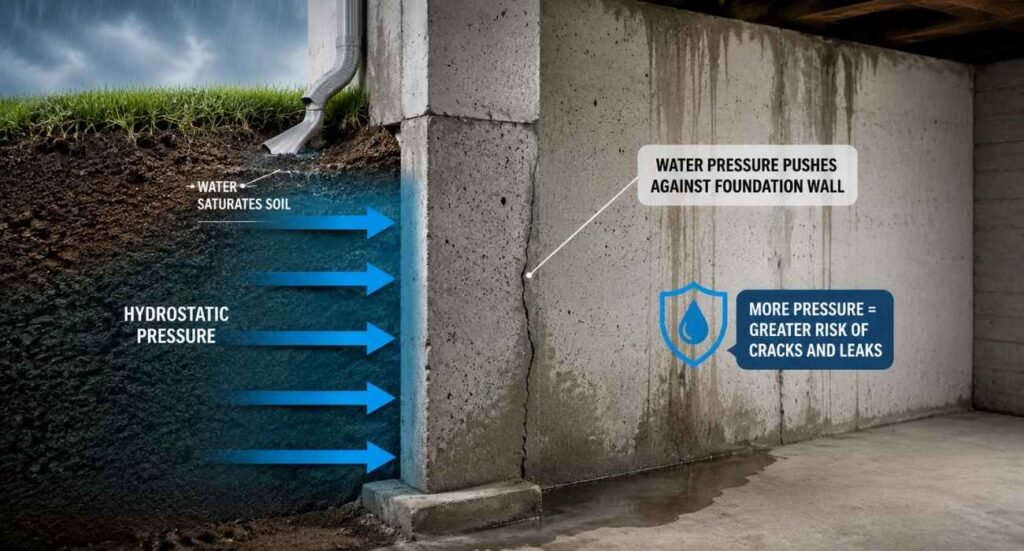
Many homeowners assume water is what damages basement walls.
More often, it’s the pressure behind the water.
After prolonged rainfall, the soil surrounding your home becomes saturated and heavier. As it expands, it pushes against the foundation wall. Engineers call this hydrostatic pressure, but the concept is simple: the more pressure building outside the wall, the harder that wall must work to keep water where it belongs.
This explains why some cracks continue leaking even after they’ve been sealed. The visible opening may disappear, but the pressure behind the wall hasn’t changed. Over time, that pressure often finds another weak point.
A lasting basement wall repair doesn’t simply seal damaged concrete. It addresses both the visible damage and the conditions that caused it. That’s the difference between a repair that lasts for years and one that only delays the next problem.
Why Experienced Contractors Start the Inspection Outside
One of the biggest surprises during a basement wall repair inspection is that experienced contractors often begin outside the home instead of in the basement.
That isn’t a coincidence.
Before recommending any repair, they’re trying to understand how water is moving around the property. Overflowing gutters, short downspouts, poor grading, blocked drainage paths, or landscaping that directs rainwater toward the foundation can all increase pressure against basement walls.
Many homeowners focus on the crack.
Professionals focus on what’s putting stress on the wall.
Understanding that difference often prevents unnecessary repairs because the visible crack inside the basement may simply be the result of a drainage problem that began outside years earlier.
Once the exterior has been evaluated, the inspection becomes much more interesting.
Instead of looking for the biggest crack, experienced contractors begin looking for something else entirely—the clues that explain why the wall changed in the first place.
What Experienced Contractors Notice in the First Five Minutes
Most homeowners focus on the crack.
Experienced contractors rarely do.
Before recommending any basement wall repair, they spend the first few minutes looking for clues that explain why the wall changed. Those observations often determine whether the problem is cosmetic, moisture-related, or structural.
| What They Check | Why It Matters |
|---|---|
| Moisture patterns | Show where water is entering and whether the problem is active or seasonal. |
| Efflorescence | Indicates moisture has been moving through the concrete for some time. |
| Wall movement | Helps determine whether the wall is stable or continuing to shift. |
| Previous repairs | Reveals recurring problems that temporary fixes may have hidden. |
| Exterior drainage | Identifies whether water is being directed toward the foundation. |
None of these clues provide the answer on their own. Together, they allow experienced contractors to understand what caused the damage and recommend the basement wall repair most likely to last.
That’s why two contractors can inspect the same wall and reach different conclusions. The quality of a repair depends less on the product being used and more on the accuracy of the diagnosis behind it.
How Professionals Choose the Right Basement Wall Repair
By the time homeowners begin researching basement wall repair, they’ve usually seen dozens of repair methods. Epoxy injection, carbon fiber reinforcement, wall anchors, steel braces, waterproof coatings—every option claims to be the right solution.
The difficult part isn’t finding repair methods.
It’s knowing which one actually fits your wall.
Experienced contractors don’t begin by recommending products. They first determine whether the wall is stable, whether it’s still moving, and whether water or soil pressure continues to affect the foundation. Only after answering those questions do they recommend a repair.
Think of two homes with nearly identical cracks. One crack formed years ago during normal concrete shrinkage and has never changed. The other continues to widen after every rainy season because hydrostatic pressure is still pushing against the foundation.
From the outside, both cracks appear similar.
From a contractor’s perspective, they’re completely different problems requiring completely different basement wall repair strategies.
The repair should always match the condition of the wall—not simply the appearance of the crack.
Not Every Basement Wall Repair Requires Structural Reinforcement
One of the biggest myths homeowners believe is that every crack means the wall needs structural reinforcement.
Fortunately, that’s rarely true.
Some basement wall repair projects involve nothing more than sealing a stable crack because the wall has remained unchanged for years. If there’s no evidence of movement, water intrusion, or structural stress, a straightforward repair may be all that’s required.
The recommendation changes when the wall itself continues to move. Bowing walls, widening cracks, repeated leaks, or displacement between concrete blocks often indicate that simply filling the crack won’t solve the underlying problem.
If the damage involves brick, block, or stone foundation walls, professional masonry services may also be required to restore structural integrity and help prevent future deterioration.
In those situations, reinforcement systems such as carbon fiber straps, wall anchors, or steel bracing may become necessary. Each solution serves a different purpose, which is why experienced contractors choose the repair based on how the wall behaves—not on which repair system happens to be the most popular.
Choosing the Right Contractor Is More Important Than Choosing the Repair
One of the most expensive mistakes homeowners make isn’t choosing the wrong repair.
It’s choosing the wrong diagnosis.
It’s common to receive two or three estimates for the same basement wall repair project and wonder why the prices are so different. In many cases, the contractors aren’t disagreeing on cost—they’re disagreeing on what’s causing the damage.
That’s why comparing estimates based only on price can be misleading. Before deciding which proposal offers the best value, compare the explanation behind it.
A trustworthy contractor should clearly explain:
- What caused the wall to crack or move.
- Whether the wall is stable or still changing.
- Why a particular basement wall repair is recommended.
- Whether drainage or waterproofing issues should also be corrected.
- How the repair helps prevent the problem from returning.
The best contractor isn’t always the one with the lowest estimate.
It’s the one who helps you understand your home well enough to make the right decision.
Basement Wall Repair Cost: What Are You Really Paying For?
One of the first questions homeowners ask is:
“How much does basement wall repair cost?”
The honest answer is that the cost depends less on the crack itself and more on what caused it.
A stable crack that only needs sealing will cost far less than a wall affected by ongoing movement or hydrostatic pressure. If drainage improvements, waterproofing, or structural reinforcement are also needed, the overall investment naturally increases.
That’s why two homes with cracks that look almost identical can receive estimates that differ by thousands of dollars.
Before comparing prices, compare what’s included in the estimate. A quality basement wall repair proposal should explain the cause of the damage, the recommended repair, and how that repair helps prevent the problem from returning.
| Factor | Why It Affects Cost |
|---|---|
| Type of damage | Cosmetic cracks cost less than structural movement. |
| Water intrusion | Waterproofing or drainage improvements may also be required. |
| Wall movement | Bowing or leaning walls usually require reinforcement. |
| Accessibility | Finished basements or limited access increase labor costs. |
| Underlying cause | Drainage, grading, or foundation issues may also need correction. |
Remember, you’re not simply paying to repair a crack.
You’re investing in a solution that prevents the same problem from happening again.
Should You Repair It Now—or Keep Watching It?
Not every crack requires immediate basement wall repair, but not every crack should be ignored either. The important question is whether the wall is stable or continuing to change.
Monitoring may be appropriate if a crack has remained unchanged for years, there’s no water intrusion, and a professional inspection confirms the wall is structurally stable. In those cases, documenting the crack and checking it periodically may be all that’s needed.
However, you should schedule a professional inspection as soon as possible if you notice:
- Cracks that continue widening over time.
- Water entering after heavy rain.
- Bowing or leaning basement walls.
- Growing stair-step cracks in masonry.
- White mineral deposits that keep returning.
- Doors or windows near the foundation becoming difficult to open.
One simple habit can also make future inspections much easier. Take clear photos of the crack every few months, especially after heavy rain or winter freeze-thaw cycles. If the crack changes in size or begins leaking, you’ll have valuable information that helps determine whether basement wall repair has become necessary.
Frequently Asked Questions
Can a basement wall be repaired without replacing it?
Yes. In most cases, the wall can be repaired without replacement, especially when the problem is identified early. The right solution depends on whether the wall is stable, leaking, or showing signs of structural movement.
Are horizontal cracks always serious?
Not always, but they should never be ignored. Horizontal cracks often indicate pressure against the foundation wall and should be professionally evaluated to determine whether the wall is still moving.
Can I repair a basement wall myself?
Small surface cracks may be suitable for DIY repairs. However, widening cracks, recurring leaks, bowing walls, or signs of structural movement should always be inspected before attempting any repair.
How long does basement wall repair last?
A properly diagnosed and professionally completed basement wall repair can last for decades. Its lifespan depends on whether the underlying cause, such as poor drainage or hydrostatic pressure, has also been corrected.
Does homeowners insurance cover basement wall repair?
It depends on your insurance policy and the cause of the damage. Sudden accidental events may be covered, while damage caused by long-term water intrusion, poor maintenance, or gradual settlement is often excluded. Review your policy or speak with your insurance provider for clarification.
Final Thought
Most basement walls don’t fail overnight. They usually give homeowners time to notice that something has changed. A crack, recurring moisture, or white mineral deposits may not always signal a serious structural problem, but they should never be ignored without understanding their cause.
The purpose of basement wall repair isn’t simply to restore damaged concrete. It’s to identify what’s affecting your foundation, choose the right solution, and protect your home from more expensive repairs in the future.
If you’ve noticed new cracks, recurring moisture, or signs that your basement wall may be changing, don’t guess. A professional inspection can determine whether the wall simply needs monitoring or whether it’s time to take action before a minor problem becomes a major repair.
Have Questions? Call NuEra Contracting Today!
📞 347-444-9028
We’re here to help with expert construction, brickwork, roofing, and waterproofing services. Get reliable solutions, friendly support, and professional results for your next project.

