You’ve noticed the same stain spreading across the ceiling tiles again. Maybe it is the third leak this year, or the roofer who patched it last spring warned that the roof is reaching the end of its service life. When repairs keep adding up without solving the underlying problem, commercial roof replacement may become the more practical long-term option.
With 27+ years of experience and more than 999 completed projects, NuEra Contracting has worked on roofing and construction projects across NYC and Nassau County. Our experience helps us understand the challenges commercial properties can face when dealing with aging, damaged, or repeatedly leaking roofing systems.
A commercial roof protects your building, equipment, employees, and daily operations from rain, snow, wind, and changing NYC weather. This guide covers the warning signs, commercial roof replacement costs, roofing systems, project timeline, and installation process so you can plan your project with a clearer picture of what to expect.
What Is Commercial Roof Replacement?
Commercial roof replacement involves removing an existing roofing system and installing a new one. Depending on the roof’s condition, the work may include removing old membranes, insulation, flashing, damaged decking, and other deteriorated materials.
Roof replacement is different from commercial roof repair. Repairs address specific problems, while replacement rebuilds the roofing system when its age, condition, or damage makes continued repairs less practical.
A professional commercial roof inspection should be completed before making this decision. An inspection can identify problems with the membrane, seams, flashing, drainage, insulation, and roof deck.
Warning Signs You Can’t Ignore
A professional inspection is the best way to determine whether a repair or full replacement is appropriate. However, these warning signs deserve prompt attention:
1. Frequent roof leaks: One leak may be a localized problem. Multiple leaks, water stains, wet insulation, or damaged ceilings across different areas can point to broader deterioration.
2. Widespread membrane damage: Cracks, tears, blisters, and open seams reduce a roof’s ability to keep water out. When these problems affect large areas, repeated repairs may no longer be practical.
3. An aging roof: Age alone does not mean a roof needs replacement. However, an older system that requires frequent repairs should receive a detailed evaluation.
4. Ponding water: Standing water after rainfall can indicate drainage problems or an uneven roof surface. Long-term ponding can place additional stress on roofing materials.
5. Damaged insulation or roof deck: Water can travel beneath the membrane and damage insulation or decking without obvious surface signs. Both conditions should be identified before installing a new roof.
6. Rising energy bills: Poor roof performance and degraded insulation can affect a building’s energy efficiency. Roofing problems may be one factor worth investigating.
7. Visible sagging or structural stress: A noticeable dip or sag in the roofline requires immediate professional evaluation because it may indicate a more serious problem.
If you notice several of these signs, scheduling an inspection before the next major storm can help you understand the condition of the roof.
Repair vs Replacement: How to Decide
A repair may be enough when the problem is limited to one area. For example, a small membrane tear, damaged flashing, or isolated leak can often be addressed without replacing the entire roofing system.
Commercial roof replacement may need to be considered when the roof has widespread damage or repeated problems. Multiple recurring leaks, extensive membrane failure, wet insulation, damaged decking, or a roof that is near the end of its service life can all indicate that continued repairs may not be the most practical long-term solution.
The decision should also consider the roof’s age, repair history, remaining service life, and your plans for the property. A professional inspection can help determine whether targeted repairs or commercial roof replacement is appropriate for your building.
Common Commercial Roofing Systems
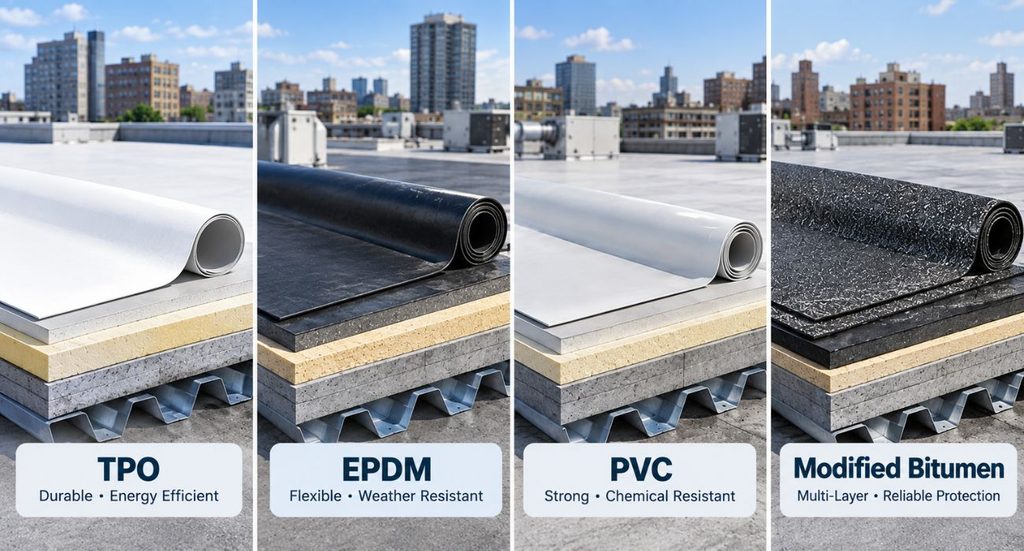
Different commercial roofing systems have different strengths, installation requirements, and costs. The best option depends on the building, roof design, existing materials, drainage, budget, and long-term plans.
| System | Common Uses | Key Considerations |
|---|---|---|
| TPO | Low-slope commercial roofs | Durable single-ply membrane with heat-welded seams |
| EPDM | Low-slope roofs | Flexible synthetic rubber membrane |
| PVC | Commercial buildings needing strong water and chemical resistance | Durable option with a higher potential upfront cost |
| Modified Bitumen | Low-slope roofs | Asphalt-based system with multiple installation methods |
| Built-Up Roofing (BUR) | Traditional commercial applications | Multi-layer system with a long history of use |
During commercial roof replacement, the selected system should match the property’s specific requirements rather than being chosen only by price.
Real Costs: What Commercial Roof Replacement Actually Runs
The commercial roof replacement cost depends on much more than roof size. Materials, labor, existing roof conditions, access, drainage, insulation, and other project requirements all affect the final price.
As a general planning range, commercial roof replacement in NYC may cost roughly $8–$20 per square foot. For a 10,000-square-foot roof, that represents approximately $80,000–$200,000 as a broad planning range. These figures are not quotes, and actual pricing can vary considerably by property.
| Cost Factor | How It Affects the Project |
|---|---|
| Roof size | Larger roofs require more materials and labor |
| Roofing material | TPO, EPDM, PVC, modified bitumen, and BUR have different costs |
| Existing roof | Removal and disposal add to project requirements |
| Roof condition | Damaged decking or insulation can require additional work |
| Accessibility | Difficult access can increase labor and equipment needs |
| Flashing | Parapets, edges, walls, and penetrations require detailed work |
| Drainage | Drains and ponding issues may require correction |
| Rooftop equipment | HVAC units and other fixtures can affect installation |
| Building location | NYC access and site logistics can affect project costs |
| Permits | Requirements vary based on the property and project |
A detailed estimate from a commercial roof replacement contractor should explain removal, preparation, materials, labor, flashing, drainage, and anticipated repairs.
How Long Does It Take?
The timeline for commercial roofing replacement depends on building size, roof complexity, weather, access, materials, and the condition of the existing roof.
| Building Size | Typical Planning Range |
|---|---|
| Small commercial — under 5,000 sq. ft. | 3–7 days |
| Mid-size — 5,000–20,000 sq. ft. | 1–3 weeks |
| Large or industrial properties | 3+ weeks |
These are general planning ranges rather than fixed schedules. Weather, material availability, roof removal, decking repairs, and rooftop equipment can extend the project.
Your contractor should provide a clear schedule so you can plan around employees, tenants, customers, and normal business operations.
NYC Factors That Affect Roof Replacement
NYC commercial properties face heavy rain, snow, strong wind, summer heat, and seasonal temperature changes. These conditions can place different types of stress on roofing materials.
Many buildings also have complex roof layouts that include parapet walls, multiple roof levels, HVAC equipment, skylights, vents, drains, and other penetrations.
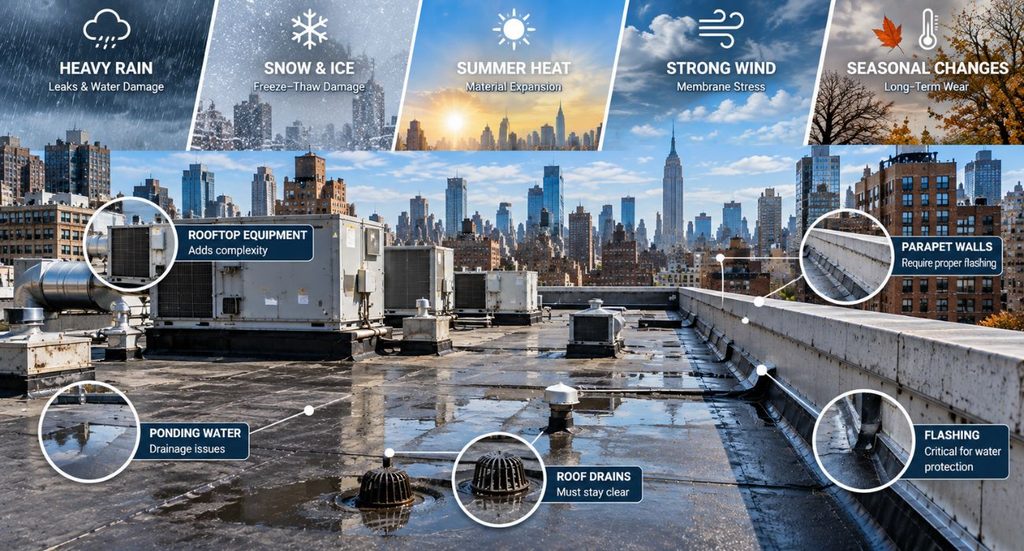
Important areas include:
- Roof edges and parapet walls
- Flashing and roof-to-wall connections
- Roof drains and pipe penetrations
- HVAC curbs and skylights
- Membrane seams
Proper detailing around these areas is an important part of successful commercial roof replacement and can help reduce future water intrusion.
Commercial Roofing Across NYC’s Boroughs
Roofing needs can vary across NYC based on building type, property density, roof design, and access conditions.
- Manhattan — Dense commercial buildings can have limited staging space, rooftop mechanical equipment, and difficult material access.
- Brooklyn & Queens — Properties range from mixed-use buildings and multifamily properties to warehouses and low-rise commercial buildings.
- The Bronx — Industrial, commercial, and mixed-use properties can have different roof ages and configurations.
- Staten Island — Commercial properties often include lower-rise buildings with different access and roof layouts.
- Nassau County — Suburban commercial and light-industrial properties may offer different staging and access conditions.
Understanding the property and its surroundings helps determine the most practical commercial roofing replacement approach.
Commercial Properties We Serve
Commercial roofing needs vary based on the building’s size, use, roof design, and daily operations. NuEra Contracting provides roofing and construction services for different commercial property types across NYC and Nassau County.
Common property types include:
- Retail buildings
- Multifamily properties
- Office buildings
- Warehouses
- Industrial properties
- Other commercial buildings
Each property requires an approach based on its existing roofing system, condition, drainage, access, and operational needs.
Can a New Roof Go Over an Existing One?
In some cases, a new roofing system can be installed over an existing roof. However, this approach is not suitable for every property.
The existing roof should first be evaluated for moisture, structural problems, damaged insulation, trapped water, and other issues. Covering a severely deteriorated system can hide problems instead of resolving them.
Full removal may be recommended when the existing roof has extensive damage or when the deck and insulation need closer inspection.
The final decision should be based on an inspection and the requirements of the proposed roofing system.
The Replacement Process, Step by Step
A typical commercial roof replacement follows several important stages:
1. Roof inspection — The contractor examines the existing roof for leaks, membrane damage, ponding, flashing problems, insulation issues, and other concerns.
2. Project planning — The roofing system, materials, scope, access requirements, safety procedures, and schedule are established.
3. Existing roof removal — Old roofing materials are removed when full replacement is required, allowing hidden damage to be identified.
4. Deck inspection — The exposed roof deck is checked for deterioration. Damaged sections are repaired before the new system is installed.
5. New roofing installation — The selected roofing system is installed according to the manufacturer’s specifications and project requirements.
6. Flashing and detail work — Flashing, parapets, roof edges, drains, curbs, and penetrations are properly addressed.
7. Final inspection — The completed roof is checked for membrane integrity, seams, flashing, drainage, and other important details.
If your building shows warning signs, a NuEra Contracting inspection can help determine the condition of your roof and the appropriate next step.
Preparing Your Business for Roof Replacement
Roofing work can affect daily operations, especially in occupied commercial buildings. Planning ahead can make the process easier for everyone involved.
- Review the project schedule with your contractor.
- Inform employees, tenants, and customers about upcoming work.
- Identify sensitive areas that need protection.
- Plan around important business activities when possible.
- Confirm safe access routes for workers and equipment.
- Discuss material deliveries and debris removal.
- Prepare for temporary noise and limited rooftop access.
Good communication before work begins can help reduce unnecessary disruption during commercial roof replacement.
Choosing a Commercial Roof Replacement Contractor
Choosing the right contractor is an important part of the project. Price matters, but it should not be the only factor you consider.
Experience and safety should also be evaluated. Commercial roofing involves workers, equipment, materials, rooftop access, and active business environments. Proper planning and job-site safety practices are important throughout the project.
Look for a contractor who:
- Has experience with commercial roofing projects.
- Provides a detailed written estimate.
- Explains the recommended roofing system clearly.
- Carries appropriate insurance.
- Follows established safety practices.
- Explains the project timeline.
- Provides warranty information.
- Explains how drainage, flashing, insulation, and penetrations will be handled.
A reliable commercial roof replacement contractor should explain what is included, what is excluded, and what conditions could change the final project cost.
Maintaining a New Commercial Roof
Proper commercial roof maintenance can help protect your investment and identify small problems before they become larger repairs.
Regular inspections should include:
- Roof membranes and seams
- Flashing and edge details
- Drains and scuppers
- Rooftop equipment areas
- Penetrations
- Ponding water
- Surface damage
- Sealants and joints
Keep drainage systems clear and address visible damage promptly. Inspections are especially useful after major storms or severe weather.
Regular maintenance does not eliminate future repairs, but it can help keep a new roofing system in better condition and potentially extend its useful service life.
24/7 Emergency Commercial Roof Repair
Roofing emergencies can happen without warning. A major leak, storm damage, exposed membrane, or sudden roof failure can put your building, equipment, inventory, and daily operations at risk.
NuEra Contracting provides 24/7 emergency roof repair for urgent commercial roofing problems. Our team can assess the damage, identify immediate concerns, and determine whether emergency repairs or commercial roof replacement may be needed.
Prompt action can help limit additional water damage and protect affected areas while a long-term solution is evaluated.
FAQs About Commercial Roof Replacement in NYC
How much does commercial roof replacement cost per square foot?
A general NYC planning range is about $8–$20 per square foot, depending on materials, roof condition, access, labor, insulation, decking, flashing, drainage, and other project requirements. An inspection and detailed estimate are needed for an accurate price.
Is TPO better than EPDM for a commercial roof?
TPO and EPDM are both commonly used roofing materials. The appropriate choice depends on the building, roof design, climate exposure, installation requirements, budget, and long-term project goals.
How often does a commercial roof need replacement?
Service life varies by roofing system, installation quality, maintenance, weather exposure, and building conditions. Regular inspections can help determine when repair, maintenance, or commercial roof replacement should be considered.
Should I repair or replace my commercial roof?
Small, isolated problems may be suitable for repair. Widespread leaks, severe membrane deterioration, damaged decking, wet insulation, and an aging roofing system may indicate that replacement should be evaluated.
What does commercial roof replacement include?
A project may include roof removal, surface preparation, decking repairs, insulation, new membrane installation, flashing, drainage work, edge details, cleanup, and final inspection. The exact scope depends on the existing roof and selected system.
Can a flat commercial roof be replaced?
Yes. Commercial flat roof replacement is common for low-slope buildings. The appropriate system depends on the existing assembly, building requirements, drainage, budget, and roof condition.
Does NuEra Contracting provide 24/7 emergency roof repair?
Yes. NuEra Contracting provides 24/7 emergency roof repair for urgent roofing problems, including leaks and storm-related damage. An inspection can help determine whether emergency repairs or a more extensive replacement is appropriate.
Why Choose NuEra Contracting for Commercial Roof Replacement
NuEra Contracting provides roofing solutions for commercial properties across NYC and Nassau County. Our services include roof inspections, repairs, installation, replacement, flat roofing, waterproofing, and other roofing solutions.
With 27+ years of experience and more than 999 completed projects, NuEra Contracting understands that every commercial property has different roofing requirements. Our team can evaluate the existing roof, identify problem areas, discuss available options, and explain the potential scope of your commercial roof replacement project.
For commercial roofing needs in Brooklyn, Queens, Manhattan, the Bronx, Staten Island, and Nassau County, contact NuEra Contracting for an inspection and estimate.
Conclusion
Commercial roof replacement is a major investment, but delaying necessary work can allow leaks, moisture, insulation damage, and other problems to become more serious. Understanding your roof’s condition, replacement options, costs, and project requirements can help you plan the work with greater confidence.
If your commercial property needs a new roof, NuEra Contracting provides commercial roof replacement services in NYC for properties dealing with aging systems, widespread damage, and recurring roofing problems. Contact our team to discuss your roofing needs and schedule an inspection.
Have Questions? Call NuEra Contracting Today!
📞 347-444-9028
We’re here to help with expert construction, brickwork, roofing, and waterproofing services. Get reliable solutions, friendly support, and professional results for your next project.

